Evidence, assembled.
Policy changes, prior-auth burden, the work your team completed, contract deadlines and rate context — turned into a packet you can hand to a payer, a CFO, or a board.
Enterprise pricing is negotiated against your payer mix and seat count. A demo runs in the product, on your payers.
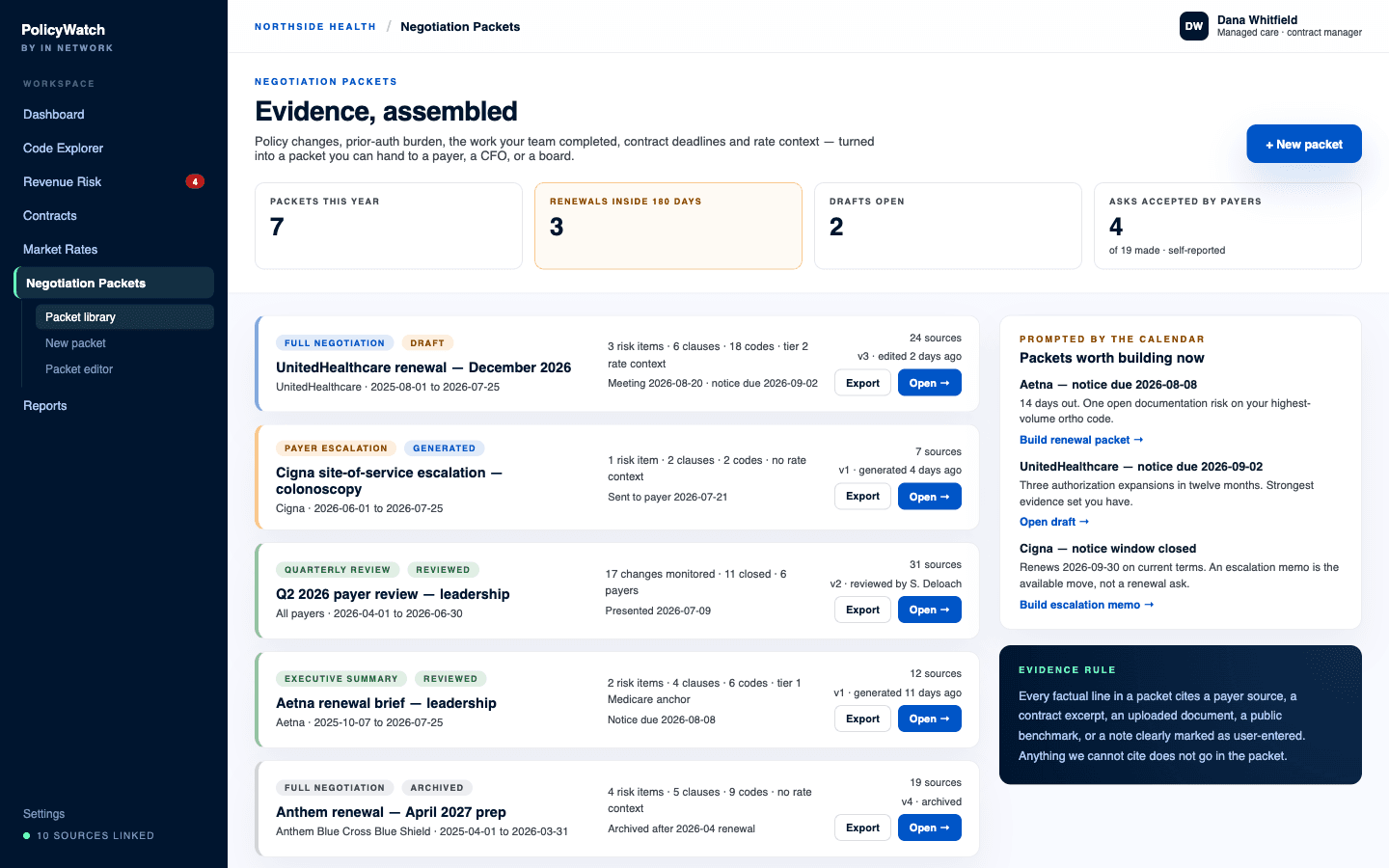
The packet library, with the calendar prompting the next build.
Four packet types, for four different rooms
The evidence is the same; the audience is not. A payer meeting, a board update, a single escalation and a quarterly review need different lengths and different tones, so the packet is chosen by purpose rather than assembled from scratch each time.
- Executive summary — a short leadership version: relationship overview, top issues, recommended asks, evidence appendix
- Full negotiation packet — renewal prep: contract and renewal context, code and service profile, policy friction timeline, risk summary, rate context, asks
- Payer escalation memo — one issue: affected codes, the exact payer excerpts, the impact, the requested resolution
- Quarterly review — the recurring value packet: changes monitored, risks detected and closed, unresolved items, actions taken
The evidence picker does the assembling
You do not start from a blank document. The packet proposes the evidence that already exists for that payer and date range, and you decide what makes the cut — which is the difference between an hour of selection and a week of collection.
- High and critical risk items from the period, and the ones still unresolved
- Repeated payer changes — the pattern is often the strongest argument you have
- Prior-authorization burden on the codes you selected
- Contract clauses, renewal dates and notice deadlines from Contract Cabinet
- Rate observations and the Medicare anchor from Market Rates, with quality labels intact
- Denial or claim examples where your team has uploaded them
Every line cites something
The rule is stated inside the product and enforced by the generator: anything that cannot be cited does not go in the packet. That is what lets someone hand the document across a table without rehearsing which paragraphs they can defend.
- An official payer policy source, quoted and linked
- A contract excerpt, with its page reference
- An uploaded claim, denial or remittance document
- A rate observation with its source file, date and quality label, or the public Medicare fee schedule
- A note clearly marked as user-entered — never dressed up as a finding
Recommended asks, written to be edited
The packet drafts the asks that follow from the evidence, each with a rationale, the items supporting it, and the codes it touches. Then you rewrite them in your own words, because the person in the meeting is the one who has to say them.
- Ask categories: rate increase, code or service carve-out, prior-auth relief, documentation clarification, timely policy notice, claims-processing correction, appeal escalation, contract language change, portal or process improvement, data sharing
- Every ask carries a rationale and its supporting evidence
- Each ask is marked payer-facing or internal only
- All text is editable, and citations stay attached through every edit
Prompted by the calendar
Packets get built late because nobody was watching the notice date. The library works the other way around: it tells you which packets are worth building now, why this window matters, and what the strongest available evidence for that payer currently is — including when a notice window has already closed and an escalation memo is the move rather than a renewal ask.
Export, version, and keep the library
Each packet is a durable record, not a one-off document. It exports print-ready, keeps its version history and its source count, and stays in the library under the payer it belongs to — so next year's renewal starts from last year's file instead of from memory.
- Print-ready export with the evidence appendix attached
- Draft, generated, reviewed and archived states, with the reviewer recorded
- Version history — v1 generated, v2 reviewed, v3 edited — kept per packet
- Filed by payer, packet type and date range, with the source count on the record
One source of truth, one loop.
Packets are the output end of the loop, and they only work because everything upstream kept its receipts. PolicyWatch detected the change, Code Explorer extracted the requirement and its quote, the Revenue Risk Queue recorded who worked it and how it closed, Contract Cabinet supplied the clause and the renewal clock, and Market Rates contributed the rate observations with their quality labels. The packet does not generate evidence — it assembles the evidence your team already produced by doing the work.
What buyers ask about Negotiation Packets.
Does the product send anything to the payer?
What if we have no rate data for this payer?
Can we change what the packet says?
Put Negotiation Packets on your payers.
Source-backed packets for renewals and payer meetings: what changed, what it costs, what to ask for.
Want to see it for yourself first? Try Policy Finder — free.